Garage & Shop Floor Slabs in Topeka, KS
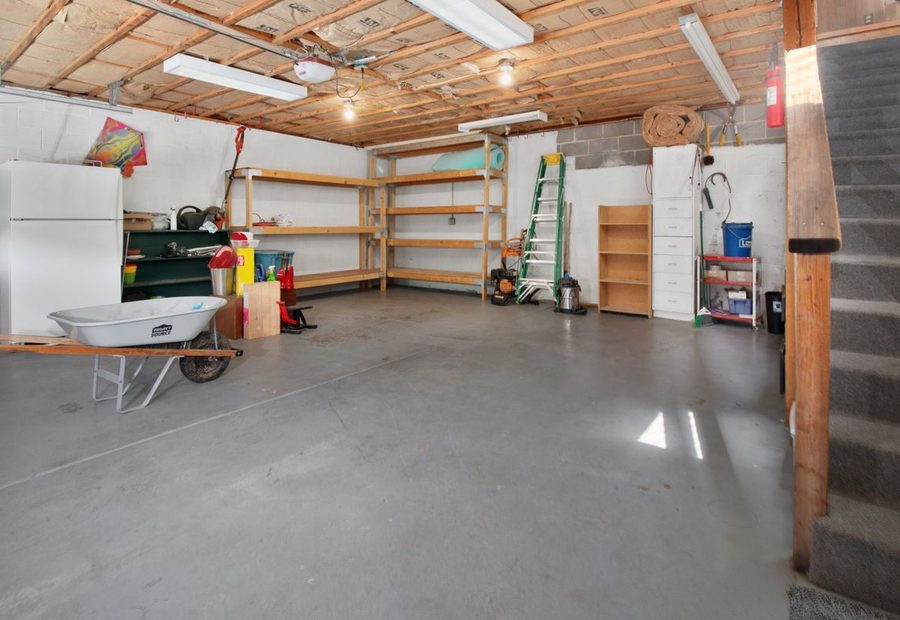
Topeka Concrete Pros pours and replaces garage and shop floor slabs for homes and small shops across Topeka and Shawnee County, Kansas. We are a licensed and insured concrete contractor. When a garage floor has cracked, heaved, or worn out, we tear it out and pour a new slab built for vehicle loads: a compacted crushed-stone base, a vapor barrier, 4000 PSI air-entrained concrete, thickened edges, and saw-cut control joints.
The slab is four inches over four to six inches of compacted crushed stone, with a poly vapor barrier between the base and the concrete and wire mesh or fiber holding it together. We thicken the perimeter and any spot that carries a hoist or a loaded trailer, because the load concentrates at the edges and the heavy points. A floor poured thin on bare clay, with no base and no vapor barrier, is the one that heaves, cracks, and sweats under a coating.
The Base Under a Garage Floor
A garage floor sits on the same expansive clay as the rest of the property, and that clay swells wet and shrinks dry. A slab poured straight on it rides the movement and cracks. We compact the subgrade, build the crushed-stone base, and set the vapor barrier, so the floor rests on ground that stays put and sheds moisture instead of pulling it up into the concrete. That is what keeps a garage floor flat under years of vehicle traffic.
Thickened Edges and Control Joints
The edges of a slab carry the wall load and the wheel loads that roll in and out every day, so we pour them thicker than the field. Inside the floor, control joints break the slab into panels and give it planned lines to crack along. A wide garage or shop gets more joints, cut on a grid, so no single panel is big enough to crack across the middle. The whole thing is finished smooth enough to sweep and rough enough to keep footing.
Tear-Out and Repour
Replacing a garage floor means getting the old one out first. We break up and remove the failed slab, rebuild and compact the base, lay the barrier, and pour new concrete. Doing it this way, rather than pouring a thin overlay on top of a floor that is already moving, is what makes the new slab last. When the job is big or access is tight, our tear-out and haul-away crew clears the old concrete first.
What It Costs
A garage or shop floor slab in Topeka runs about $4,000 to $10,000. A standard two-car garage floor sits at the low end. A large shop, thickened sections for heavy equipment, or a tear-out of a badly heaved floor sits higher, since there is more base and more slab in the job. Every floor gets a free written estimate first.
Working around a garage floor that is cracked and heaving? (785) 555-0172 gets you a free look. We pour garage and shop slabs in Grantville and across Shawnee County.
Why is my garage floor cracked and heaved in the middle?
The slab moved because what is under it moved. A garage floor poured on loose fill or bare clay heaves when the ground swells and cracks when it settles. Vehicle wheels and jack stands work the weak spots harder. We replace it on a compacted crushed-stone base with a vapor barrier under the slab, so the floor sits on ground that holds still instead of clay that does not.
Do I need a vapor barrier under a garage slab?
Yes, and it does two jobs. It keeps ground moisture from wicking up through the slab and darkening the surface or lifting a coating, and it works with the base to keep the floor stable. We lay a poly vapor barrier over the compacted base before the pour. Skipping it is how you end up with a floor that sweats and a coating that will not stick.
How thick should a garage or shop floor be?
Four inches over a compacted base for a normal garage, and thicker where heavy loads land. We thicken the edges and any spot that carries a lift, a hoist, or a loaded trailer, since the load concentrates there. The control joints are cut to break the floor into panels so it cracks along the joints instead of across the open slab.
Can you pour a slab for a detached shop or garage?
Yes. A detached shop or garage gets the same build as an attached one: compacted subgrade, crushed-stone base, vapor barrier, reinforced air-entrained concrete, thickened edges, and control joints. We size the thickness to what you park and work on inside, whether that is a car, a truck, or shop equipment.